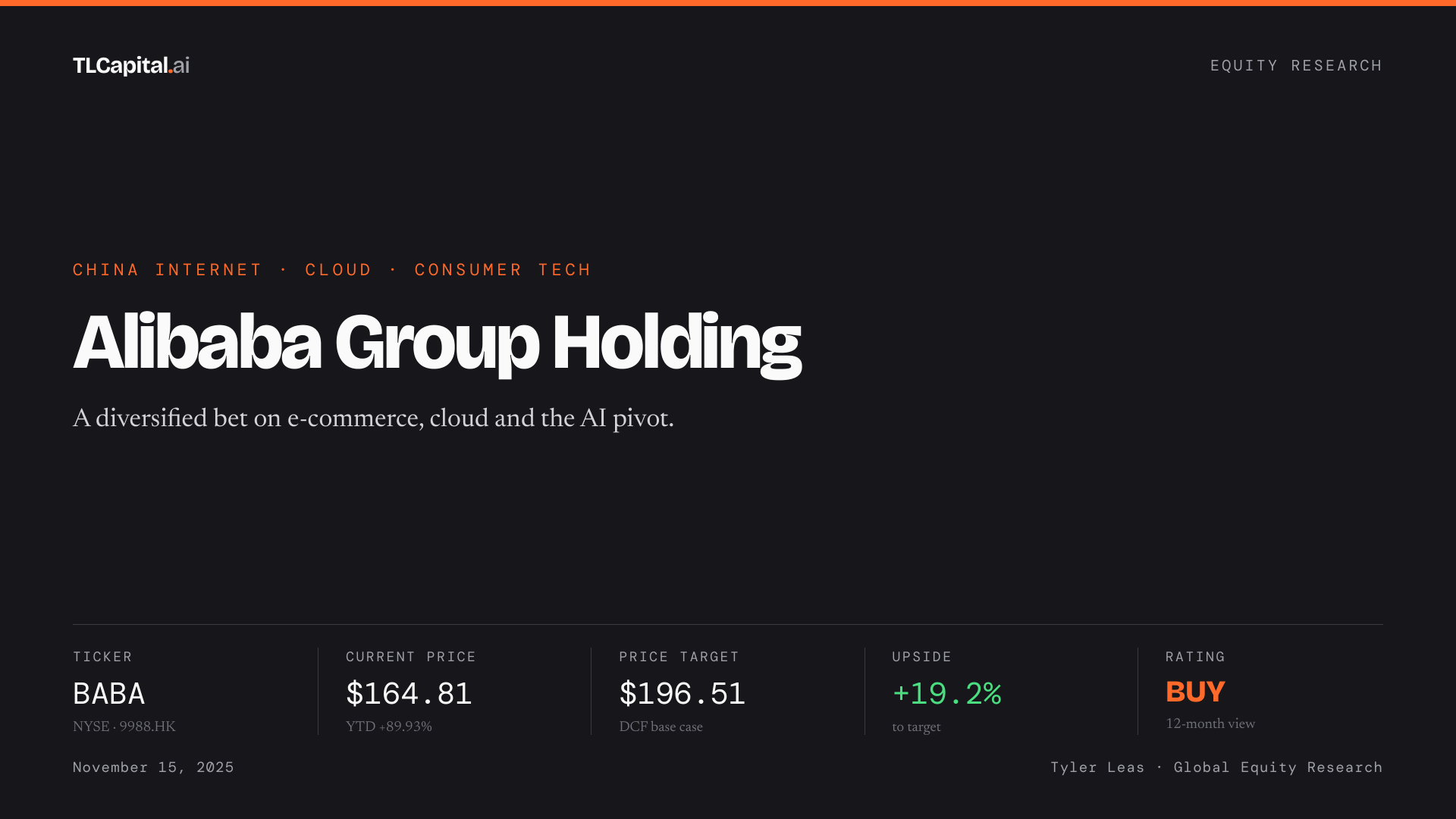
Last November I put a Buy on Alibaba. Since then the stock has gone the wrong way on me, and I want to talk about that in the open, because I think the reason it is down has very little to do with what the business is actually worth.
Here is what I am seeing.
The original call
My thesis was never about the old Alibaba, the capex-light e-commerce machine. It was about the transformation: a company reinvesting hard into cloud and AI infrastructure, sitting on a fortress balance sheet, with a dominant ecosystem and policy finally turning supportive after years of crackdown. The Qwen ecosystem and the push into custom silicon were the upside I did not think the market was paying for. The full EIC analysis, SWOT, segment build, assumptions, and DCF are all in the full research deck.
What has actually dragged the stock, and why I read it as technical
This has been a pile-on of headlines, not a broken business. In early June the Pentagon added Alibaba to its “1260H” list of Chinese military companies. Alibaba denied it outright and is fighting it, but the tape did not care. Weeks later, Anthropic publicly accused Alibaba’s Qwen team of improperly accessing its models, and the stock printed a 16-month low. Add a still-soft Chinese consumer and the Iran and Hormuz overhang from earlier this year, and you get a multiple compressing on fear, not cash flows falling apart.
The Anthropic accusation, and why I think the bears are misreading it
Let me be straight about the irony. Anthropic just paid $1.5 billion in 2025, the largest copyright settlement in US history, to settle claims it trained Claude on millions of pirated books. OpenAI, Meta, and Google are all in court over how they sourced their training data too. So a company being accused of cutting corners to get AI capability is not the scandal the headline makes it out to be. Right now, that is table stakes in this industry.
But here is the part that matters for the thesis. The bear take is that if Qwen leaned on Anthropic’s model, it proves Alibaba has no technological or IP moat, that they are just distilling someone else’s work. I think that gets it backwards. Even if they did learn from a frontier model, that does not weaken the product, it makes it better. Alibaba’s moat was never “we have the smartest raw model on earth.” It is that they own a massive e-commerce ecosystem, a place to test, fine-tune, and deploy that intelligence into something purpose-built for commerce that nobody else can replicate. Taking what you learn from the best model available and adapting it to your own use case is how technology has always moved forward. It is like saying that because algebra came from Arabic mathematicians, no one after them was allowed to learn it and make it their own.
Why I still have conviction
China’s AI players are in a race to the bottom on pricing right now, and the competition is fierce. But I do not think price is where this gets won. The moat gets built when these companies integrate their models directly into real businesses, and that is exactly where Alibaba is positioned. They already own a world-class e-commerce ecosystem, and they have been wiring Qwen straight into it, which gives them something most labs do not have: a live, large-scale proving ground for the use case. The tell is that Western companies are now building on it. Airbnb leans on Qwen heavily and chose it over ChatGPT, Shopify has deployed it, and Uber Eats is reported to be using it too.
On the capex
Are there soft spots? Yes, the capex ramp especially, and I will not pretend otherwise. But Alibaba has committed about $53 billion to AI and cloud over three years. Alphabet and Meta each spend more than that in a single year. It is the same AI-infrastructure playbook the whole sector is running. Alibaba is just doing it at a fraction of the absolute spend, and nobody is calling those US balance sheets broken.
The takeaway
When a high-quality business sells off for technical reasons while the long-term setup is quietly improving, that is the kind of dislocation I pay attention to. I laid out the full case, the model, the valuation, and the risks, in the deck. Read it and tell me where I am wrong.
I will be updating this thesis after Alibaba’s next earnings call. If you want to see whether this technical selloff was the opportunity I think it is, follow along.
Glossary
- Capex: capital expenditure, money spent on long-term assets. Here, AI data centers and chips.
- DCF: discounted cash flow, valuing a company by its projected future cash flows.
- Distillation: training a smaller or newer model on the outputs of a larger, more capable one.
- Fair use: a legal doctrine allowing limited use of copyrighted material without permission.
- IP moat: a durable competitive advantage rooted in intellectual property.
- Moat: a durable competitive advantage that protects a business from its competitors.
- Technical vs. fundamental: price moving on flows and sentiment, versus on the actual health of the business.
- Qwen: Alibaba’s family of open-source AI models.
Disclosures
This post is for informational and educational purposes only and reflects my own independent research and opinions. It is not investment advice, and it is not a recommendation, offer, or solicitation to buy or sell any security. I am not a licensed financial advisor, and nothing here is a substitute for professional advice tailored to your situation. All investing carries risk, including the possible loss of principal, so do your own research and consider consulting a qualified financial professional before making any investment decision.
Formatting and layout assisted by AI. All research and analysis by Tyler Leas.
I am long BABA and have been adding on the way down to lower my cost basis. My primary concern is geopolitical and regulatory risk, particularly related to U.S.–China tensions and China’s domestic policy environment. While Alibaba is expanding its international footprint across Southeast Asia, the business remains predominantly tied to China.